By Nicole Hyman and Cody Olson
Over this past year, hundreds of thousands of couples have had to move or postpone their wedding day due to Covid-19. Is it the responsible and safe decision? Yes, absolutely, but, that doesn’t make it any less difficult. A wedding takes months to plan and coordinate, and there are so many variables to account for. Countless engaged couples are now grappling with the arduous task of rethinking their special day, and all the difficult feelings that come along with that process. We, at UConn Pre-College Summer (UConn PCS), can’t fully relate to this feeling, but we know a thing or two about having to cancel a “special day.”
After months of planning, we made the difficult decision to cancel our 2020 Pre-College Summer program to prioritize the health and safety of our students, faculty, and campus partners. As a team that works year-round to prepare for a few special days in the summer, we did not make this decision lightly.
While we did not host a program, we made sure our summer did not go to waste. We spent time reflecting on the best aspects of our program, rethinking a few of our offerings, and retooling as we prepare for next summer. Our 2021 program will certainly look different, but that doesn’t mean it will be any less engaging, exciting, or enriching. While we were planning and preparing this summer, we came to the realization that we
would need to figure out how to marry our typical offerings to the university’s e-learning and technological capabilities. Weirdly enough, the marriage of technology and our program was not the only wedding related thought we’ve had. In fact, as we reflect on the work we completed since March, we can’t help but notice a matrimony motif emerge. Our efforts may be best categorized with the old wedding day adage: Something old, something new, something borrowed, and something blue. Our major projects from this past summer reflect these categories, and we are optimistic they are helping us work towards a “ring”er of a summer.
“Something old, something new, something borrowed, and something blue. Our major projects from
this past summer reflect these categories, and we are optimistic they are helping us work towards a “ring”er of a 2021 summer.”
Something Old: Rethinking Student Workshops
For the UConn PCS team, summer 2020 meant adapting an older and integral component of our program: exploratory workshops. Traditionally, workshops allowed students a safe, in-person space to explore a wide variety of emerging academic and personal interests in addition to their class. Many of our wonderful workshop presenters worked with the PCS team to transition their work shop into a recorded virtual mini-workshop that was shared out with students who registered for the program. We understand that many students spend their summers preparing for their futures, and we were pleased to continue supporting students in their college and career preparations in a virtual space. These workshops all pertain to college preparation, and can still be accessed on the Pre-College Summer YouTube Channel.
Something New: A New Graduate Assistant
For the UConn PCS team, summer 2020 brought a new teammate: a new Graduate Assistant, Deanna Gallegos. Deanna joined the team in August and hit the ground running working on social media and preparing to recruit, hire, and train our summer staff. While summer 2021 is looking different than those prior, Deanna is working to ensure that our student staff will have a safe and engaging experience. She has spent the last month rethinking the role our student staff will play and making sure that by the end of the summer our staff will have enhanced their leadership capabilities and grown in their professional competence. Deanna is from West Sacramento, CA and graduated from the University of California – Davis in 2019 with a double major in English and Chicana/o Studies. She is now pursuing a Master’s in Higher Education and Student Affairs in the Neag School of Education at UConn. We are elated to have her on the team!
Something Borrowed: Relationship Building and Benchmarking
Collaboration is a key component of our work as a program. Conferences provide our team with opportunities to connect and network with other pre-college programs across the country and the partnerships we’ve formed with other UConn offices are integral to creating a dynamic summer program. Building and maintaining relationships has been a challenge as of late, but this summer we set out to create a community of practice with similar programs on and off campus.
The community we are building came to fruition after our Program Coordinator, Cody Olson, conducted a benchmarking analysis this past summer. Since the completion of that project, we’ve been able to develop stronger relationships with other programs, share new and innovative ideas with our peers, and in many ways “borrow” unique practices and strategies that we will
implement in coming summers. A project like this would not have been possible to complete in a typical summer, and the community of practice we are building will benefit us for years to come.
Something Blue: A New Pre-College Website
For our new website and branding, “something blue” means adopting a dynamic, minimalist design to bring us closer to our UConn Nation roots. This summer, we had time to develop a new website and rebrand the program- a major undertaking and something we may not have been able to do without the extra time we had this summer. It’s not just the look of our website that has changed. We have also restructured the website to better address the specific needs of three different populations. We want to directly communicate with students, parents and guardians, and high school and community partners as well as other program stakeholders. With education entering a new age of online and blended learning, we are excited to share our new website and to use it to better serve our students and their families.
Rain Date: Planning for Summer 2021
Like most happy couples planning to celebrate in 2020, we have a rain date for Summer 2021. We are thrilled to be in the midst of preparing for this upcoming summer as we utilize the old, new, borrowed, and blue ideas from our unexpected summer of collaboration and growth. We are excited to announce that #SummerAtUConn for 2021 will be held virtually. This includes online course offerings, workshops, and social programming for our student participants. Students can now submit an application at no cost by navigating to connect.pcs.uconn.edu/apply. For a list of courses that will be offered, please see this link: pcs.uconn.edu/courses. Among the many courses that will be offered, we have a great opportunity for students interested in Geoscience. Through a collaboration of UConn’s Department of Geoscience & UConn PCS, scholarships will be awarded to students to participate in the three-week virtual GEOPATHS: Introduction to Geosciences course at no cost. Visit pcs.uconn.edu for more information on this scholarship and overall program details.
2021 Summer Dates:
• Session 1A & 1B: 6/14/2021 – 7/2/2021
• Session 2A & 2B: 7/5/2021 – 7/23/2021
“We want to directly communicate with students, parents and guardians, and high school and community partners as well as other program stakeholders. With education entering a new age of online and blended learning, we are excited to share our new website and to use it to better serve our students and their families.”
 We also had the opportunity to interview Camila Lopez, a sophomore at J.M. Wright Technical High School who spoke about the political events that affected both her family and her education. When asked about how her peers were getting involved with political issues she answered, “Here in Stamford, there have been a lot of protests downtown,” and continued by saying, “there are issues going on that need to be spoken about, and I’m a big fan of peaceful protesting.” When asked if today’s current events have also been addressed within the classroom she said, “Yes, especially since I’m taking the UConn ECE Human Rights course our teacher was like, ‘yeah we’re talking about this’. What I really like about it, and what a lot of students I’ve seen like about it, is there’s more real-world subjects.” She went on to say that she liked the platform students were given in class to speak their minds, especially in her UConn Human Rights course. She mentioned that, “What I like about it is the flexibility that the teacher has, like if there is a problem going on [our teacher will say], ‘does anyone want to talk about it?’ He’ll give us the platform so we can say what we’re thinking and then we start discussing it. There aren’t necessarily debates or arguments about it, it’s just discussing it in general which is really nice.” Camila also mentioned that she and other students believe bringing up these issues in class is the first step to bringing about change. “There’s a curriculum but because it’s a human rights class you can kind of go off of it in different directions. You can have an assignment on race, but because there are still racial inequalities today, you can talk about what’s going on today.” Camila also mentioned that although students were quieter in their online classes, once a conversation was started on a controversial topic or current event, students were more willing to jump in and share their thoughts. She reminisced about being in the classroom in the beginning of the year and explained, “Once one person starts [the conversation], it kind of goes from there, and with a couple of people joining it leads to more. I feel like with online classes a lot of kids are quieter than I’m used to seeing in class.” And although high school students may not be as outgoing or willing to participate over Zoom, Camila emphasized that their voices are still being heard. Towards the end of the interview, we asked Camila how the political discourse had affected her family. Her response was, “I’m Guatemalan and I love talking about politics with my dad.” Once again she mentioned that talking about these issues is one of the most important things students are doing. At the end of the interview Camila reiterated how important it was to spread awareness about current topics in the class room, and to keep students involved in the conversations.

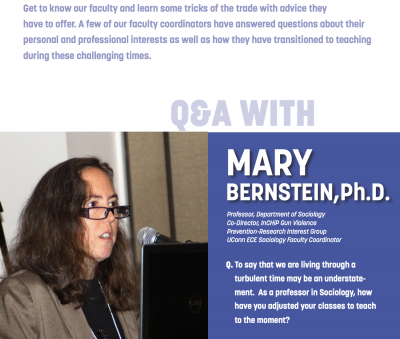 I think that COVID-19 has really focused public attention on the collective health and mental well-being of those around us. It has also laid bare the racial and economic inequities in our society. As faculty, it is incumbent on us to help students understand the origins of these disparities in institutional racism and racist ideologies that have produced such gross inequities.
 The unequal racial impact of the pandemic has brought the racial inequities of our society into stark relief. For many European-American people, the murder of George Floyd by police officers in Minnesota laid bare the racism embedded in the criminal justice system and sparked uprisings across the country. For Black and Brown people, the police murder of Floyd was one more example of a criminal justice system where Black and Latinx people who constitute approximately 25% of the population make up 59% of the prison population. Compared to similar nations, the U.S. incarceration rate is five to ten times higher. Understanding structural racism is a critical part of what sociologists study. With the increased organizing for racial justice, there are myriad ways for students to get involved and they can start by looking online. For those who do not feel safe protesting in person, many social movement organizations now meet online which I believe for many makes participation easier, though of course, we all miss the in person contact. Whatever issue you care about, whether it is climate change or voting rights or something else, you can find a group that is working for positive social change.