ECE

Celebrating Languages with UConn ECE


by Jessica Dunn 


Congratulations to the following high schools for participating in the 2019 UConn ECE Student Language events:


Bristol Central High School  Nathan Hale Ray High School 
Cheshire High School  Newington High School 
Coventry High School  Norwich Free Academy 
Edwin O. Smith High School  North Haven High School 
Glastonbury High School RHAM High School 
Granby Memorial High School Staples High School 
Lewis S. Mills High School 


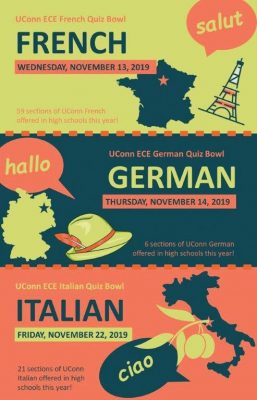
November was UConn Early College Experience’s month of celebrating languages! For the first time, UConn Early College Experience hosted three different Language Immersion Days which included a competitive Quiz Bowl to culminate each event.


We started our celebrations with our 19th annual UConn ECE French Immersion Day and Quiz Bowl Competition on November 13, 2019, closely followed by our new UConn ECE German Immersion Day and Quiz Bowl Competition on November 14th, and wrapped up with our new UConn ECE Italian Immersion Day and Quiz Bowl Competition on November 22nd.


For each event, UConn ECE Students from across the state came together on the UConn Storrs Campus for a day of immersion and fun competition in the respective language of the event. In the morning of each event, students participated in academic sessions with department specific UConn teaching assistants and competed in a Quiz Bowl Competition in the afternoon. The academic sessions reflected the interests of the TAs, and all lessons were given in the respective language of the event. Each participating high school put forth a team of up to four UConn ECE Students to compete in the afternoon Quiz Bowl Competitions, which were moderated in French, German, or Italian. The Students were then required to answer in the same language that the questions were presented to them in.


All day, students were given the opportunity to be culturally immersed in the language by practicing their vocabulary and pronunciation, tuning their ears to new voices speaking foreign languages, learning about different cultures, and interacting with other Connecticut high school students who have a passion for learning a second (third, fourth, fifth, etc.) language. With just about 250 students in attendance for all three events, it was apparent the Students were very enthusiastic about being at the UConn Storrs Campus and excited to engage with the UConn ECE Faculty and Staff over a love of languages.


As this was the first year for the German and Italian Immersion Days and Quiz Bowl Competitions, we look forward to these events growing and becoming annual events as French has for many years. With UConn courses in Chinese, Latin, and Spanish as well, we hope to grow the number of student events in the languages in the future.
Transitioning to College: Passion, Learning, and Leadership


by Brian Boecherer


Passion is something we tend to avoid talking about in modern society. Perhaps we feel that when we express our pure excitement about something, we leave ourselves vulnerable to criticism or embarrassment. This is especially true when we are passionate about something that we are not yet an expert on. As students we are often excited by what we are learning, not knowing all the possibilities or implications of this new exploration. Yet I have found with my own students that they are reticent to share their thoughts on these passions. My sense is that they don't want to be asked any questions because they are at the beginning stages of a great exploration and would rather protect their excitement than risk feeling like "a student".


Being a student is an important role and a title that is central to my identity. I love learning and the longer I have been a student, the clearer it becomes that sharing my thoughts and passions on what I read is central to being a great student. We should always be considering and reevaluating our academic passions, as well as sharing our thoughts with important people around us. When I graduated high school I had pretty clear ideas on what I wanted to study but not very clear ideas on how I was going to use it. I loved foreign languages and politics. I was lucky to have studied Russian throughout my four years in high school and was very excited to continue learning Russian and start learning German at UConn. Some people encouraged me to go into international business, because, that's where the money is. Luckily I was surrounded by people who supported my interests and allowed me to focus my passions without monetizing them. It made my studies and self­ discovery that much more enriching. I did not go into business; rather, I stayed at the interesting crossroads of language, culture, and politics. True to a liberal arts education, my degree prepared me to do a broad array of things because I learned how to analyze and problem-solve and was practiced at applying rigorous methodologies of inquiry. All of these skills have benefited the Office of Early College Programs and allowed me to do interesting things with my life.
During my doctoral work in political science, I started to study the relationship between people and government, and especially the hidden nature of hierarchies. People at the top of the hierarchy seldom realize that a hierarchy exists and also do not always realize how their actions influence others in relationship to them. This dynamic of power is important to consider as we make big transitions in our life - from high school to college, college to the job market, and new employee to leadership. As our relationships change, so do our positions in the hierarchy. As we leave high school it becomes more apparent that we fill several roles at the same time - as a leader and a role model for those in high school, and a novice and aspirant in the environment of higher education. Yet we are all part of this fluid continuum.


Finding one's academic passions may be easy or difficult, but it is made easier by sharing our interests with those around us. We learn from each other all the time. Taking a moment to talk to your professors is the single most important thing a student can do. Starting a conversation is easier than one may think. Visit the office hours on the third or fourth week of the semester and express your thoughts on the readings and the class. I have made lasting relationships with professors by visiting their offices and expressing an interest in discussing the topic deeper or asking where my interests may lead me professionally. Additionally, start to see yourself as a leader. In that role, make time for others. Ask questions about their interests and contribute your thoughts. Higher education is still about learning and while gainful employment is the ultimate goal, our application of education makes that final connection. Your knowledge, networks, and passions will lead you in directions where job opportunities exist. The more we reach out to support each other, the richer our lives and community will be.


2018-2019 UConn ECE Professional Development Awards


By Jessica Dunn


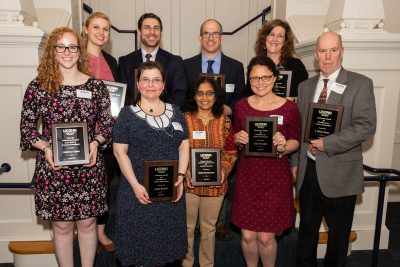
This year there were many outstanding nominees, reflecting the high enthusiasm and support the UConn Early College Experience community has for one another and the program. UConn ECE Instructors and Administrators were nominated by their colleagues and students for their exemplary instruction and management of the UConn ECE program. This year nine Professional Development Award winners were selected, across six different award categories, which only happens every few years. We typically present awards in five different categories, but were privileged this year to present a well-deserved Award for Outstanding Research in the Field of Concurrent Enrollment to Kathrine Grant, a UConn undergraduate. Kathrine is only the second person in UConn ECE's history to be presented with this award.


We recognized all award winners at our annual Awards Ceremony in April, presenting them with a plaque and a monetary award over a celebratory dinner with family, friends, and colleagues. It was a night full of admiration and appreciation for the dedication each award winner displays day in and out for their high schools and their students. All award winners have exceeded the program expectations and excelled in preparing their students for the next level in their education.
 

The UConn Early College Experience program would not be successful without passionate and dedicated Instructors and Administrators. It is a true honor to work alongside such enthusiastic educators who go above and beyond program expectations and work tirelessly for the well-being and success of their students. On behalf of all of us at UConn ECE, we applaud our Instructors and Administrators from across the state for their hard work and dedication to the program, and we are forever grateful for you.


We are pleased to announce our 2018-2019 UConn ECE Professional Development Award winners:
Thomas E. Recchio Faculty Coordinator Award for Academic Leadership
Nalini Ravishanker, Statistics
Site Representative Award for Excellence in Program Administration
Seth Korn, Newington High School
Principal Award for Program Support and Advocacy
Mary Kay Tshonas, Quinebaug Middle College
Instructor Award for Excellence in Course Instruction
Alina Britchi, Physics - Westbrook High School
J. Mark Peters, European History - Shepaug Valley High School
Peter Vermilyea, u S History - Housatonic Valley Regional High School
Sara Dziedzic, Human Rights & Political Science - The Woodstock Academy
"Rookie of the Year" Award for Excellence in First-Year Course Instruction
Kristina Sluzewski, Human Development and Family Studies - Wilton High School
Award for Outstanding Research in the Field of Concurrent Enrollment
Kathrine Grant, UConn Undergraduate


2019 UConn ECE Scholarship Winners


by Jessica Dunn


This year we received about 200 applications, each one telling a different story of a UConn ECE Student's journey through their high school education. The high quality of the applications made it very difficult for the review committees to choose only six winners. Each applicant clearly demonstrated high academic achievement and a potential for future accomplishments in their chosen field, but there were six applications that stood out amongst the rest.


We are honored to have such amazing students in the program this year and are proud of their dedication to their future education. Award recipients received a certificate of accomplishment along with a $500 monetary award to use towards post-secondary education expenses. UConn Early College Experience (ECE) is pleased to announce the 2019 student scholarship winners to the UConn ECE community.


And the winners are ...


Excellence in Arts, Humanities or Social Sciences
Hebatalla Mohamed, Rockville High School
Chloe Veth, Daniel Hand High School
Excellence in Science, Technology, Engineering or Mathematics
Nicholas Nguyen, Sport & Medical Sciences Academy
Edgar Dias, Manchester High School
Excellence in Civic and Community Engagement
Sonya Hadley, Middletown High School
Skylar Haines, RHAM High School


We wish you well in your future endeavors. Congratulations!

Spring Professional Development Events


by Stefanie Malinoski


UConn Early College Experience Faculty Coordinators offer annual professional development workshops for their Instructors. This spring, we hosted UConn BCE Instructors from eighteen different departments on campus. Highlights from some of the most exciting events are below:


Animal Science: Our certified Animal Science Instructors along with Faculty Coordinators
Dr. Jenifer Nadeu and Dr. Amy Safran met with
Dr. Julia Wilkinson from Tufts Veterinary Field Service to learn about equine aging and dentistry in a hands on science lab. The group of 12 certified Animal Science Instructors were able to tour the horse barns and observe Dr. Wilkinson floating a horse's teeth. This routine procedure involves filing a horse's teeth to make the chewing surfaces relatively flat or smooth as a part of overall equine health.


Biology: Dr. Thomas Abbott, Faculty Coordinator for UConn ECE Biology, and a group of fifty certified instructors discussed all things insects. Special guest speaker, from UConn's EEB department, Professor David L. Wagner shared his research on caterpillars with the group in an interactive presentation during the morning. In the afternoon, Instructors were able to tour UConn's Research Greenhouses under guidance by Living Plant Collections Manager, Clinton Morse. Instructors walked through each zone getting to take a close look at the thousands of plants thriving in the greenhouses. Later groups of Instructors were able to visit the Biodiversity Research Collections with Dr. Sarah Taylor and Dr. Jane O'Donnell who shared a variety of samples from the Collections with the Instructors.


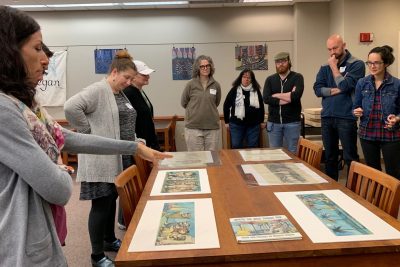
Art: Along with UConn ECE Faculty Coordinator, Cora Lynn Deibler, certified UConn ECE ART 1030: Drawing I Instructors were able to visit the Thomas J. Dodd Center on the Storrs campus to take a firsthand look at the Maurice Sendak archives. Recently, the Maurice Sendak Foundation chose to share Sendak's archives with the University of Connecticut who are now housing and stewarding the Collection. Project Archivist, Carla Nguyen shared her knowledge with the group who were able to learn more about Sendak's life, and view his original artwork, sketches, books and other materials.
 

Spanish: Faculty Coordinators for Spanish Dr. Ana Maria Marcos-Diaz and Dr. Eduardo Urios-Aparisi invited special guest Dr. Angel Rivera, Associate Professor of Spanish and International Studies at Worcester Polytechnic University to campus for the event. Dr. Rivera presented his research titled: "Un acercamiento teorico a la naturaleza del horror, la ciencia ficcion y los monstruos en la literatura del Caribe" (A theoretical nature of horror, science fiction and monsters in Caribbean literature). Later in the day, UConn ECE Instructors competed in groups writing their own short stories to share. Winners were awarded UConn ECE prize packs.

Concurrent Enrollment: A Model of Development as Freedom

 
By Brian Boecherer
 

About five years ago, when taking courses for my doctorate in political science, I took a graduate class on economic rights. In this course I read a famous book entitled, Development as Freedom, by Nobel Laureate Amartya Sen. Dr. Sen makes the point that economic and political freedoms are linked and that the more we support the economic development of a country, the more the political freedoms in the country will grow. Poverty makes people vulnerable to being used by others (government, regional hegemons, etc.) as it keeps education low, it reduces the opportunities for personal independence – especially for women – and it restricts individual and group advocacy for other human rights. I find myself recalling this book from time to time, especially when I teach my students on topics of identity and rights enjoyment.


As I write this article for our newsletter, the week of Thanksgiving, I am recalling the arguments of the book again in response to an editorial in the Chronicle of Higher Education

(11/5/2017) that argues concurrent enrollment (programs like UConn ECE) are contributing to inequalities for students. In his article, Dr. Erik Gilbert, from Arkansas State University, suggests that his introductory history class has lower enrollment than in past years because students are taking course” while in high school. The result, he concludes, is that he has fewer students and, he adds, there are “fewer middle-class, suburban, white students [in his class].” He argues that because of concurrent enrollment, he has fewer students, more of which are minority and adult students. On this basis, he argues that universities that provide such programs are contributing to social inequalities at the university and they should be ended.


Dr. Gilbert is imbedding many assumptions about the nature of inequality into his editorial, but the point I believe he is trying to make is that a heterogeneous group of students makes for more diverse classroom discussions. This is certainly true; however, his argument, which is anecdotal, only holds together if we limit the arena to select general education courses at a university. His observations that concurrent enrollment is contributing to inequality does not consider the arena of the high school nor does it consider the issue of being admitted to a university. It does not consider that when a university invests in a quality connection with high school faculty, staff, and students, the entire educational enterprise benefits. The more we develop the partnerships, the more diverse populations that can benefit from this option.


It is important to start the conversation with framing the original intention of our program, that is, to make the senior year in high school more interesting, engaging, and beneficial for both students and instructors. UConn is the oldest concurrent enrollment program in the country, so the national conversation starts here in Connecticut. In 1954 Provost Waugh suggested that if we can work with the best and most credentialed high school instructors in the State, we can create an educational system that transforms all levels of high school education so that lower level classes prepare students for UConn courses – whether they be taught at the high school or at UConn itself. Provost Waugh also wanted to combat the problem of seniorities, something he attributed to boredom in the classroom. When you look at education as being a lifetime pursuit and on a continuum, the ability to offer college courses while in high school often rescues students and instructors by offering differentiated learning. Using the arguments of Dr. Sen, we are increasing the development in the high school, which results in increased student access, an awakening of one’s own academic interests, and the ability to invest in different University classes before going to college. As we seek to work with all high schools at an affordable rate and waive student fees for those in need, we are investing in the development of Connecticut.


There are many studies that suggest that when a student changes majors in college that their time to degree completion increases, which increases student debt, and delays entry into the job market or a more advanced degree. When students earn credits through UConn ECE, they are earning a currency which increases their competitiveness

when applying to college, preparing them for college rigor in advance of college, and in most cases giving them credits that allow them to move forward with their own academic interests once in college. This currency buys the students options. Moreover, students make these explorations and advancements in an environment where time and money are not inextricably connected. One of our most notable successes of the program has been the diversification of course offerings, which has increased the number of our high school partners. This has been at the core of my development strategy since 2005. At that time we offered 20 different classes; now we offer 70. Diverse course offerings allow for a diversity of students. Taking just one class allows students to see themselves as college worthy, and broadens access to future engagement in higher education.

 
What we do, collectively, is offer students freedom through development. Concurrent enrollment is the best system to provide this freedom at an affordable rate. I am suspicious of arguments, like Dr. Gilbert’s, which suggest that concurrent enrollment is contributing to inequality and that the only answer is to end these partnerships between high schools and universities. The pursuit of equality should not result in a lowering of the ceiling so no school and no student grows higher than another. We need to offer a diversity of opportunities, because we live in a world of diversity.


I hope you enjoy this year’s ECE newsletter magazine, it is filled with articles that highlight our engagement as a community and reminds us of why we commit to this task. Our best remedy to inequality is education and access.Concurrent enrollment is a model of development as

freedom.

UConn ECE Surpasses 2013-14 Enrollment Record

In the 2013-14 academic year, UConn Early College Experience hit what we thought might be an enrollment plateau. We reached the record high of 10,000 students enrolled in ECE courses. We then faced the challenge of decreasing overall high school populations, and the new and unfamiliar online Compass registration system was launched. Taking these challenges into account, we were satisfied with only a slight dip in enrollments for the 2014-15 year, bringing in over 9,800 students.
Not ones to rest on our laurels, our 2015 strategic plan looked at ways to continue to grow our program faced with the challenges at hand. The quest became two-fold. First, we sought to rebuild relationships and recoup enrollments lost by the transition to online registration. UConn ECE staff members made dozens of “house calls” this registration season to assist schools and students that were struggling with the new process. The second strategy was to grow course offerings by expanding existing programs, and by bringing new school partners into the ECE family.
The strategy worked! The 2015-16 academic year saw a record 10,812 students enroll in UConn ECE
courses. Many schools have increased enrollments due a higher comfort level with the online registration system while other schools have added new courses. We also have seventeen new or returning high schools offering ECE courses this year.
With more and more focus on the benefits of dual and concurrent enrollment at the state and national level, we will continue to expand our relationships and make process improvements to insure continued
growth and success for students for years to come.

STEM, HASS, and Our Community of Education

by Brian A. Boecherer
When reading any newspaper or education journal these days, it is nearly impossible not to see an article on the importance of STEM education. A Google News search of STEM results in an average of 12.6 million news articles daily. This year alone, the Federal budget for STEM education was suggested to be $2.9 billion, an increase of 3.7 percent. The acronym does not even need to be defined in the news, because it is now an established part of our lexicon.
Naturally, in so many ways, the emphasis on STEM education is essential to our present success and comfort as well as our future development and longevity.  UConn ECE has worked for many years with the departments at UConn to establish diverse STEM offerings to our high school partners. We recently added engineering to our offerings, complementing our rich offerings in plant science, soil science, environmental science, math, biology, chemistry, physics, and other courses. On page 4 & 5 of the newsletter, you can see the breakdown of course offerings in these areas. We are proud of these
offerings as they support a diverse education as well as a gateway into many STEM and non-STEM majors.
As we all push to strengthen the STEMs in the country, we must also not forget the importance of the Humanities, Arts, and Social Sciences (HASS). Education in these areas is just as important. And while the acronym invokes images of the avocado, the humanities, arts, and social sciences benefit both science and our society; inspiring creativity, developing our culture, and allowing science to be applied in beautiful, functional, and engaging ways. Indeed, Human Development and Family Studies is a required
course for nursing majors. Likewise, math and science courses are required to graduate from the University.
UConn ECE offers many rich opportunities in all these areas. Moreover, UConn ECE supports small
departments as well. This fall it was so much fun to attend the ECE Classics Workshop and listen to the dynamic conversations for Latin and Ancient Greek instructors. I learned that the Latin instructors were recruited as the first computer programmers due to their logic and eagle-eye precision. While our Italian offerings are at only 10 percent of partner high schools, it is also the second most popular second language spoken in Connecticut, and we enjoy supporting those communities.
In short, we like supporting the interests and passions of education; educators and students. Our micro programs are as vibrant as our large programs. All of our programs are communities and academic neighborhoods. Our advice is do not trade one for the other, but build a diverse UConn ECE program so all students are supported in multiple ways.

UConn Early College Experience Credit Transfer Database

By Melanie Ochoa & Magdalena Narozniak

UConn Early College Experience is happy to announce the release of the Credit Transfer Database, a resource tool now accessible to all students, parents and affiliates intended to demystify the misconceptions surrounding credit transfer. Students taking University of Connecticut courses through UConn Early College Experience do not need to attend UConn to use their earned credit. Credits are widely accepted throughout the nation and normally transfer along the lines of transfer credit. Yet, there are many institutions that do not accept concurrent enrollment credit or any transfer credit – that’s why getting information early in the college application process is crucial.
The Credit Transfer Database is designed to be a guide when identifying potential credit transfer opportunities and problems. Including over 980 accredited institutions in the United States, the database provides credit transfer policies specific to concurrent enrollment and rates the likelihood of successful credit transfer from courses offered at the University of Connecticut through UConn Early College Experience to institutions elsewhere in the country. The general information found in the policies allows students to explore options for transferring credits. The policies can contain a range of information from required grades for transferability to potential meetings with an advisor and submission of official transcripts.
The transfer credit policies are rated on a zero-to- five star scale with five and four stars indicating a high likelihood that credits will transfer successfully. Some policies ranking five stars will be so detailed
that precise course credits will be listed if accepted. Institutions with one, two, and three stars may
require some extra effort on the part of the student to get the credit transferred, like submitting a course syllabus for evaluation. Institutions with zero stars will not accept concurrent enrollment credit. Even if an institution will not accept credit, students should be reminded that they also benefited from the
experience and by taking college courses while still in high school, they appear more competitive in the
application process. Under no circumstance does the UConn Early College Experience Credit Transfer
Database guarantee acceptance of transfer credit as it
is only meant to be a guide.
The database is an outcome of the 2013 Concurrent Enrollment Credit Transfer Study, performed at the University of Connecticut and supported by a NACEP Small Research Grant. The study was conducted in three parts: a survey of U.S. admissions officers and registrars, an in-depth Alumni survey and extensive data mining of publically available transfer policies. Based on those results and the results of annual Alumni surveys, we can say with confidence that UConn credit earned through UConn Early College Experience transfers at a rate of about 87%. Not only were the institutions in the database chosen based on where our alumni are attending but, top universities and colleges from popular ranking sources were also included.
The UConn Early College Experience Credit Transfer Database can be found at http://ece.uconn.edu/ research/. Want to see a transfer credit policy of an institution not found in the database? Let us know by contacting us at ece@uconn.edu.

The Biggest Branch: UConn ECE Celebrates 60 years

By Brian Boecherer
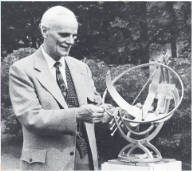
In 1954, University Provost Al Waugh was out of control. That is, it seems, no one wanted to control him as he started the University on its academic development plan of the age. Provost Waugh was known for many celestial things; building the first planetarium in Connecticut (1954), his foundational texts on sundials, and his creation of UConn Early College Experience.
In December of that year, Provost Waugh convened a special committee of University leadership and three high school principals to express his distress over how less-motivated students get the lion share of time from good teachers. In high school, he believed, it created a space for academically talented students to waste their time and lose their motivation. For this reason he wanted to build a relationship with local high schools to establish UConn courses at the high school to fight what would eventually be known as “senioritis”. The program was called  The Cooperative Program for Superior Students. By September 1955 seven schools were able to get instructors certified and for the first time in the United States, 108 students were taking university courses on the high school campus.
Over the years, the program developed and grew; expanding course offerings and increasing the number of high school partners. Two decades later, under the leadership of Biology Professor Albert Kind, the program had 77 high schools and 2,300 students. In an interview with The University of Connecticut Chronicle,one University administrator described the Co-op program as “the biggest branch” of the regional campuses. Not only was Co-op building its reputation in Connecticut, but also other universities contacted UConn for guidance to develop their own concurrent enrollment programs. Indeed, we occasionally tease Syracuse University of a letter in our archive where they honor our program with kid-brother-esque admiration; soliciting our advice.
After the leadership of Professor Kind in the 1980s, the Co-op program started to decline under several changes in leadership, most of whom were part-time directors. Incredibly in the mid-1990s there were even conversations of ending the program because it was too costly to manage.
In 1999 Michael Menard, Ph.D. was the new face of the program and the engine for recovery. For the first time in its history a $5 per course fee was charged to students which led to improved professional development and site visits. This period was really the rebirth of deep faculty engagement and our collaboration in founding NACEP.
Over the last decade, the program developed dramatically under Jill Thorne, Ph.D. first with all new (and increased) staff, a dramatic name change to UConn Early College Experience, as well as a serious engagement with NACEP. In this period expectations were elevated, professional development was expanded and improved, academic rigor more accurately recorded, aProfessor Al Waughnd the program invested in research to understand the program as a vital tool for student success [see article of transfer credit database Page 4]. Indeed, we are a national model for concurrent enrollment and are peers with other elite universities like Syracuse University, Indiana University, and the University of Washington. While the program has certainly grown and developed over the last 60 years, the core of the program has stayed the same. UConn ECE is dedicated to deep academic partnerships that provide access to and preparation for higher education at the high schools. We value our relationship with the departments and the high schools, and look forward to continued strength as we work together for student success.