Spotlight on Laurie Wolfey!

 
By Melanie Ochoa
 

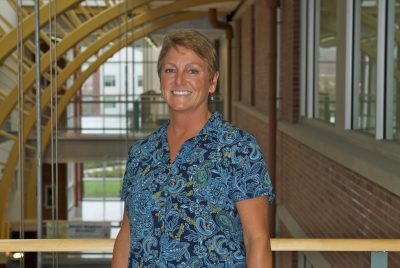
The Faculty Spotlight is a chance to get to know UConn ECE Faculty Coordinators and highlight the wonderful work they do. This year’s Faculty Spotlight is dedicated to Laurie Wolfley, 2016-2017 award winner of the Thomas E. Recchio Faculty Coordinator Award for Academic Leadership. Laurie is the UConn ECE Faculty Coordinator for American Studies and Maritime Studies.


1. How did you get involved with UConn ECE?
About 10 years ago, Maritime Studies needed help coordinating its ECE program, and folks at Avery Point, where the MAST Program lives, knew that I’m a certified high school teacher who teaches lots of maritime literature and is deeply invested in interdisciplinary work; I guess I just fit a need at the time. I’ve been full-steam ahead since then


2. What is your philosophy of teaching and learning?
I believe that the students I teach need a safe, caring and compassionate environment in which to discover themselves as individuals; they need the freedom to think critically and creatively—to take risks and determine their own values through in-depth inquiry and discussion with others. They also need to be challenged to acknowledge and accept their responsibilities and to respond appropriately to those challenges. My goal is to encourage students to reach their own conclusions, find their own voices, and express those voices with clarity and confidence through a variety of communication mediums.


3. What do you consider to be one of your greatest achievements? Why?
Though perhaps not the greatest achievement of my life, what resonates here and now is my current success at surviving each day as a long-term substitute teacher at Fitch High School. I’m immersed in a several-months-long teaching gig that has me flat out every day, then doing my typical stint at UConn in the evening. I am grateful for the amazing support I’ve gotten from the Fitch faculty and staff—and from my terrific students…but I am dead tired. I’ve always applauded the work ECE teachers do, but this experience has provided me with tremendous appreciation for all the high school teachers I’ve worked with in the ECE Program over the years and for public school teachers in general.


4. What are your hobbies?
I love to cook, hike, kayak, ski, garden, and spend time reading in the back yard among the chickens. (I’ve hardly had a chance to consider these activities since the sub job started.)


5. What was your favorite course you ever took in college?
I think my favorite course was Children’s Literature, which I took with Bud Church at Connecticut College. I am fortunate enough to teach that course occasionally at Avery Point, where I still emulate much of what Bud did in my own class many years ago.


6. What is the best advice an instructor can give to students on their last day of high school and/or college?
Don’t sit around waiting to become the person you hope to be when you grow up. It’s too late; you’re already there. I was astounded to find that I was at 30 and then later at 50 the very same person I had been at 17. Take the reins and do your thing. Forgive all the stupid things you’ve done in the past, accept responsibility for yourself now, and move on.


7. What would you recommend students do to succeed in a UConn ECE class?
Recognize that you are an adult, and act like one: Take responsibility for your learning, push yourself to value learning over receiving high grades, ask questions, and think critically and creatively about your coursework. Look for the joy in learning.


8. If you were a superhero, what would your super power be?
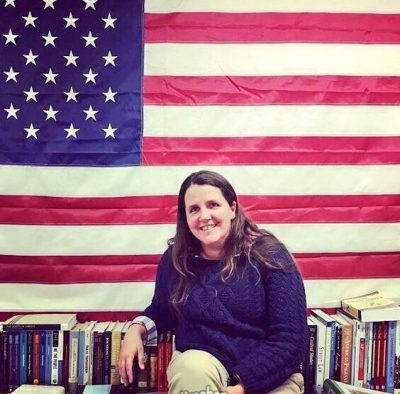
Superheroes are overrated. It’s hard enough simply being me; any more power or responsibility and I might just implode.Photo of Laurie Wolfley
In Boland We Trust: Connectcut’s 2017 History Teacher

 
By Jack Greenwood Jr.
 

The Gilder Lehrman Institute is the nation’s leading American history organization dedicated to K-12 education. This year, Katie Boland was a part of 52 State History Teachers of the Year who were awarded by The Gilder Lehrman Institute for their outstanding effort and ability to promote the understanding of American history.


Effectively teaching the subject of history can prove to be challenging since it is generally the relaying of the story of how something came-to-be, while at the same time, emphasizing the relevance of how past decisions affect and influence how we think and operate today. With that said, the subject of history can be fairly bland if the teacher just spends class time lecturing and not interacting with the students or getting them involved. Although Boland formally teaches the UConn ECE Political Science course (POLS 1602: Introduction to American Politics) at Trumbull High School as a certified ECE instructor, it is clear that she has the potential to make any space into a classroom. She wears a smile that is accompanied by an enthusiastic personality which brings her teaching to life. Boland was quoted in a Trumbull Times article saying, “The key [to teaching] is to make it interesting and interactive. I try not to do straight lectures, like what I grew up with.” To make the class more interactive, Boland would have students construct their own arguments for famous court cases, such as the Supreme Court’s United States vs. Texas 2016 decision, and have other students hear the case and make a final decision. This is just one example of an innovative way to get the students involved that is emphasized by the passionate teaching of Boland.


Katie Boland seems to understand the importance of having someone lay down the groundwork for something great to be built upon it. When asked what her favorite historical era was, she responded with “[The] founding of our nation is my favorite historical era because it not only lays the foundation of our country, but also gives us the mandate to keep the republic alive.” Here, it is the foundation of the history courses that has been established, but it is up to Boland to continuously implement relevant teaching methods to keep the subject of history alive and engaging in our ever-changing young generations.


It also appears that the founding of our nation is not just a personal interest for Boland, as her class enjoys this particular era too. Boland says, “My We the People students love debating the Founding Fathers. We often have discussions in class about the most influential Founding Fathers/Mothers and the most overrated ones.” Students have explored their founding-of-our- nation interests even further by completing assignments such as writing a eulogy for their favorite founding father/mother and then presenting it to the class. It seems to be clear that Boland has manufactured a way to truly connect with her students and immerse them into the world of history. Boland’s genuineness was reciprocated by her students when they surprised her with a birthday party shortly after they had just won the State Championship for the We the People competition, which is where teams of students compete against one another to test their knowledge of the U.S. Constitution. When Boland entered her classroom, students jumped from their hiding spots and began to sing “Happy Birthday” while they presented her with a large, cardboard, cutout of her favorite founding father, George Washington, and a bobble-head figure of her other favorite, Alexander Hamilton.
 

Along with earning the History Teacher of the Year award, Boland will receive a $1,000 honorarium and an invitation to a 2018 Gilder Lehrman Teacher Seminar which is a weeklong program that offers teachers daily discussions with eminent historians, visits to historic sites, and hands-on work with primary sources. In addition to this, Trumbull High School’s library will receive a core archive of American history books and Gilder Lehrman education materials.
 Photo of Katie Boland

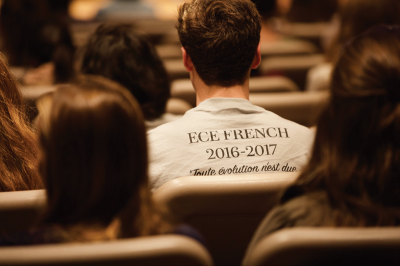
2017 UConn ECE French Immersion Day and Quiz Bowl Competition

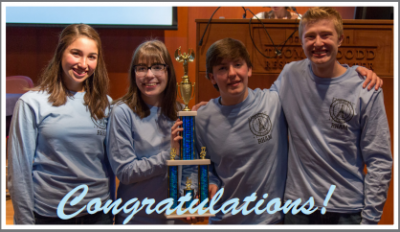
On November 1, 2017, UConn Early College Experience held this year’s French Immersion Day and Quiz Bowl Competition. We enjoyed the company of Nathan Hale Ray High School, Coventry High School, Lewis S. Mills High School, RHAM High School, Portland High School and Norwich Free Academy ECE French students as they competed for the Quiz Bowl Champion. Taking home first place in this year’s Quiz Bowl Competition was RHAM High School, followed by Portland High School in second place, and Norwich Free Academy in third place. The competition put the knowledge of the French ECE students to the test, but they all performed well and showed their love for the course. Congratulations to all participants for taking on the challenge of broadening your French expertise.
Quiz Bowl Winners 2017

National Alliance of Concurrent Enrollment Partnerships (NACEP) 2016 Conference

By Nella Quasnitschka
On October 16th, a group of UConn ECE staff hoofed it to Louisville, KY to attend NACEP’s 2016 National Conference themed, The Triple Crown: Quality, Collaboration & Transition. With over 770 educational leaders from almost every state in attendance, it was a year of change for NACEP as The Board of Directors presented a new strategic plan to help the organization move forward in the coming years.
The conference committee offered copious opportunities to learn, share new practices and network in over 60 breakout sessions that focused on all aspects of concurrent enrollment. Various tracks included
effective program management, policy & advocacy, standards & accreditation, and research & program evaluation. Included in the long list of workshop presenters was our very own thoroughbred, Magdalena Narozniak, Program Coordinator for Research and Development. Magda’s presentation titled, “Demystifying Assessments: Quality Outcomes and Quality Data Presentation,” focused on which outcomes related to enrollment are best suited to assess programs and examples of how UConn ECE presents and uses assessment data for impactful improvement.
Since 2004, NACEP has served as a national accrediting body for concurrent enrollment partnership
programs. Applicants must present evidence documenting how their college or university has implemented NACEP’s national standards in the areas of: curriculum, faculty, students, assessment, and
program evaluation. This year, eleven colleges and universities earned accreditation and were recognized at the Accreditation Recognition Ceremony. This extensive accreditation process helps institutions validate the quality of college courses offered in high schools and ensures the academic rigor matches the standards of the sponsoring post-secondary institution.
A team of six well-bred ECE staff represented UConn at the conference. We submitted a third place poster into the Marketing Competition, presented a workshop, and shared best practices. We even had a
little fun with our colleagues at a dueling piano bar after a long day of workshops and meetings. We learned, networked, and impressed others with our knowledge of running the oldest, and one of the largest, most successful concurrent enrollment program in the nation! Our poster didn’t clinch the win but we plan to train hard and go back next year stronger than ever! See you in 2017.
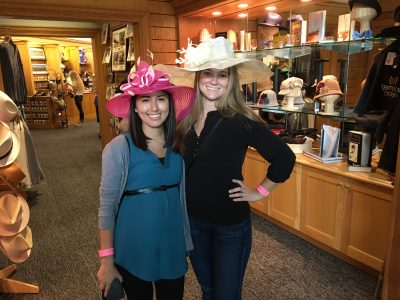
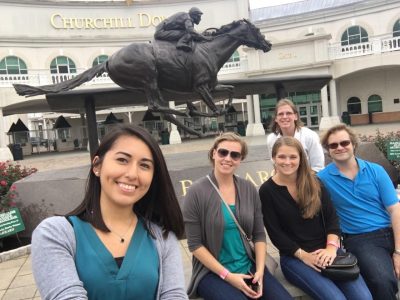
Jess and Melanie at NACEPThe group at NACEP

New Student Scholarships Introduced

By Wendi Richardson
UConn Early College Experience is pleased to announce three new student scholarships to be awarded in May 2017.
Scholarships will be given for: Excellence in Arts, Humanities or Social Sciences (2 awards); Excellence
in Science, Technology, Engineering or Mathematics (2 awards); and Civic and Community Engagement
(1 award) Students competing for the excellence awards must demonstrate academic achievement and a potential for future academic and professional accomplishments in their chosen field. Qualified applicants for the Civic and Community Engagement Award must demonstrate ambition and self-drive evidenced by outstanding achievement in both school and their community. All applicants must have taken or be currently taking at least one UConn Early College Experience course.
Award recipients will receive a certificate of accomplishment along with a $500 monetary award to use
towards post-secondary education expenses. Awards will be presented by UConn ECE staff at the student’s high school award event.
Applications for the new scholarships will be accepted from February 15, 2017- March 30, 2017. Scholarship details and application requirements can be found at: ece.uconn.edu/home/about/awards

Student Ambassadors Provide Support to Their Schools and UConn ECE

By Wendi Richardson
At the February 2016 Site Representative Conference, UConn Early College Experience introduced its new student ambassador program. The growth of the ECE program brought about the need for more
support in the high schools during the heavy registration cycles. The ambassador program was developed to support the high schools and the ECE community as a whole.
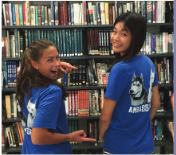
UConn ECE Ambassadors are a team of enthusiastic students that are not only enrolled in ECE courses, but are also willing to talk about it. Select students from the high schools are chosen as UConn ECE Ambassadors. These students assist in the marketing and administration of the ECE program by supporting fellow students and the Site Representative at the student’s high school. Student ambassadors commit to a one-year term where they help with ECE registration and make presentations on the benefits of the UConn ECE program. They also keep the ECE office informed about the great things that are going on in their high schools. As part of their commitment, ambassadors submit photos and videos with ECE classroom happenings which are then shared with the UConn ECE community through social media pages. In exchange for their services, UConn ECE Ambassadors are rewarded
with an ECE course of their choice, a coveted husky dog Ambassadors tee shirt and a letter of recognition at the end of their term.
In the first year of the program there were fifty-seven student ambassadors in place at thirty-eight high schools. Participating schools reported that the extra support was key to the success of their ECE
program. The UConn ECE office was also thrilled with the results, having received dozens of priceless photos of students, classrooms and events at partner schools around the state.
For more information about the UConn ECE Ambassador
program, contact Wendi Richardson at the ECE office.
Applications for 2017-2018 student ambassadors will be
accepted beginning in March 2017.
ECE Ambassadors ECE Ambassadors

The Development Plan

By Brian Boecherer
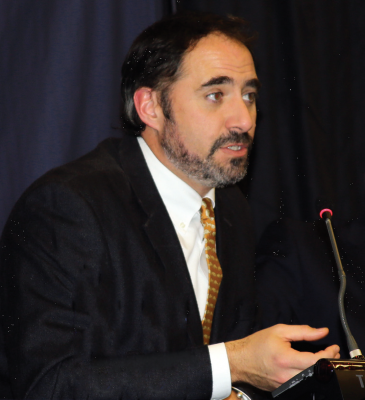
The audience was riveted. Our guest speaker for the October Political Science workshop, Professor Akhil Reed Amar, lit-up the room with his conversation on the election. The last time the country was in a similar position was 1864, he said, when the election had the chance of pulling all four levers of government in the same political direction. Prof. Amar clarified that in this election, just like in Lincoln’s second campaign, it is completely possible to have a result where the president, the House, and the Senate could all shift to either completely Democratic or Republican controlled. If this were to happen, the nominee for Justice Antonin Scalia’s position would also be from the party in power. The next justice, who will be nominated and elected under the new government, will shift the balance of power. As we now know, all four levers of power did/will move in one direction. Professional development workshops should always be so engaging and so informative.
Prof. Akhil Reed Amar is the preeminent scholar on Constitutional law in the country. His expert analysis has been cited in a score of Supreme Court decisions and his name has been mentioned as a possible nomination for Scalia’s seat on the bench (not by the Trump administration though). We were
honored and quite fortunate to have him as our guest speaker, the result of UConn ECE Instructor Aaron Hull (Greenwich High School) who was previously acquainted with him.
The Political Science workshop is an example of a larger UConn ECE effort to deepen our academic impact on the ECE community. A year ago UConn ECE examined budgets and reapportioned funds to deepen our academic investment in faculty and students. We have always been very proud to receive feedback that our workshops are the best PD faculty attend all year. But these comments spurred us to reach even higher. Departments like Biology forged the path already a few years ago, when Dr. Tom Abbott, faculty coordinator, designed his workshops to get ECE faculty back into the labs, the greenhouses, and using equipment that is generally inaccessible to high school faculty.
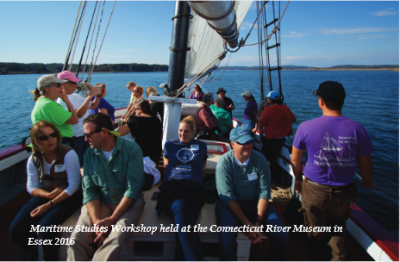
Departments have been using these new financial resources in unique ways. U.S. History hosted experts from the Pequot Museum in November to lead a discussion on indigenous approaches to teaching U.S. History. Last spring Statistics purchased specialized software called R and organized an online Summer Institute to learn proficiency. Maritime Studies hosted their annual workshop offsite at the Connecticut River Museum. In December, UConn ECE Chinese (pilot program) will host a leading scholar on the teaching and learning of Chinese, where workshop attendees will receive a complementary copy of her
textbook.
The development plan for UConn ECE has always been built around rigorous academic standards. NACEP standards were a guiding light for our development, just over 10 years ago. Now that NACEP
standards are institutionalized, our new endeavors are the deepening of academic resources. Additionally, UConn ECE is hosting a number of small grant opportunities to develop the classroom and the community. There are also student scholarships and opportunities for increased student participation, like the hugely popular UConn ECE Ambassador program. This edition of the newsletter will highlight many of the new development initiatives. We hope you enjoy reading about them, we hope you enjoy participating in them, and we welcome your input always.
Maritime Studies Workshop

Check out Matthew McKenzie’s Faculty Spotlight!

By Melanie Ochoa

The Faculty Spotlight is a chance to highlight UConn ECE Faculty Coordinators and the great work they
do. The first spotlight goes to US History Faculty Coordinator, Matthew McKenzie, 2015-2016 award
winner of the Thomas E. Recchio Faculty Coordinator Award for Academic Leadership and star of UConn ECE’s first Welcome Video. Matthew joined the UConn ECE community as the American Studies Faculty Co-Coordinator, and has additionally taken the role as the United States History Faculty Coordinator.
1. How did you get involved with UConn ECE?
It was part of the job. NO one had told me that when I applied, but I was thrilled to learn that I would be
working with ambitious, talented, and creative High School teachers. It seemed to me the best of both
worlds: I could enjoy working with my students and could support others working with theirs.
2. What are your current research interests?
I’m finishing a history of the 20th century New England fisheries. As a follow up, I am speaking with
researchers in Canada and Australia about expanding that project to examine the ecological and social impacts of the global expansion of otter trawling (dragging). Pretty arcane stuff, but it’s important.
3. What is your philosophy of teaching and learning?
Care. A lot. That’s pretty much it. If you care about your students, colleagues, and institution, you’ll do
your best. If you care about those people who have passed, you’ll be a better researcher. Just care.
4.What do you consider to be one of your greatest achievements? Why?
Raising my son: he’s an amazing kid: happy, considerate, smart, kind, tough, and at only eight years old,
argumentatively precocious (he’s going to be a lawyer, I can see it already). The extent to which I had anything to do with who he is today, well, I’d be proud of that. The truth is, though, he is who he is: he made that.
5.What are your hobbies?
I love being outside. I hike, camp, canoe, kayak—the usual mix. I’m also a bow hunter—a hobby that taught me to look at forest ecosystems entirely differently. If I ever get any time again, I might build another boat: then again, I don’t use the one I did build—but it was a lot of fun doing it.
6.What was your favorite course you ever took in college?
I took a History of the Enlightenment course with Jan Golinski in grad school. He assigned David Wilcox’s Measures of Times Past, and Kuhn’s Copernican Revolution. Those books showed me how fluid scientific understandings—and even our understanding of measuring time—have been. I wasn’t expecting that and the course blew my mind.
7. How many UConn ECE U.S. History instructors are currently certified?
80 instructors.
8.What is the best advice an instructor can give to students on their last day of high school and/or college?
Pay attention—to everything you see. And travel, as much as you can.
9. What is your all-time favorite book?
Wow. Probably Tolkien’s works (I know, I’m cheating with that answer). As a folklorist, he was a master of inventing histories with the quirks and surprises that made them seem real.
10. What would you recommend students do to succeed in a UConn ECE class?
Pay attention.
11. If you were a superhero, what would your superpower be?
Seriously? Do I really have to answer that? I think I would be a mean fiddle player. I’m not sure that’s a
superpower, but good violin players are superheroes to me.
Photo of Matthew McKenzie

2016 UConn ECE French Immersion Day and Quiz Bowl Competition

On November 3, 2016, students from the following high schools, Cheshire, Rockville, Coventry, EO Smith, RHAM, Glastonbury, Portland and Southington participated in the 2016 UConn ECE French Immersion Day and Quiz Bowl competition. The day was full of education and fun for these UConn ECE French students and their instructors. First place went to Glastonbury, second place went to E.O. Smith and third place went to Rockville High School. Congratulations!
French Quiz Bowl Winter 2017

UConn ECE 2016 Small Grant Winners

By Magdalena Narozniak
For the first time, the UConn Early College Experience offered Small Grants for Classroom and Program
Development to our high school partners. The office set aside $10,000 for the UConn ECE community available to high school instructors through a competitive grant process. The purpose of the grants is to
create an opportunity for classroom and community development for a UConn ECE course. The classroom grant can be used for books, technology, equipment or other materials that enable students to learn the subject matter or skills. Community grants may include projects that have a large impact on the surrounding community, including projects that eliminate an eyesore, make communities healthier, or foster creativity. Applications must have the support of students, principals, and UConn faculty coordinators.
The office received fifteen incredibly competitive applications from schools all over Connecticut. Applicants sought funds for textbooks and advanced pieces of equipment like Spectrophotometers, miniPCRs, and a theremin, campus visits, and a series of nationally recognized speakers. Projects for the community included community gardens, a butterfly sanctuary, a project targeting the hygiene of young impoverished women, and a solar panel system. Out of these incredible proposals, six winners were fully funded and two applications were partially funded.
Among them:
William Schultz and several other instructors of Enfield High School applied for the purchase of a solar
panel system and additional physical outputs to be used in the classroom and in community outreach events for demonstrations and experiments relating to renewable energy conversations. Experiments will include electrical, chemical, and mechanical energy conversions in the UConn ECE Chemistry, Biology, Environmental Science and Physics courses.
April Kelley of Laurelton Hall at Academy of Our Lady of Mercy applied for funds to build a hoop-
style greenhouse in the corner of the campus designated for green learning. The intention is to use the greenhouse as an outdoor classroom, to let students participate in a farm-to-table experience and to allow community gardening, fostering stronger ties between students and senior citizens living in the senior complex next door. Students of UConn ECE Environmental Science will construct the greenhouse.
Lisa-Brit Walhberg and Sarah King of the Master’s School proposed a collaborative community-based learning project designed to address the psychosocial effects of war and resettlement on refugees in Connecticut. UConn ECE Political Science and English students will be instructed in journal making, journal writing, and art activities to foster and develop global citizenship, social justice and diverse cultural awareness. Students will be trained through IRIS (Integrated Refugee & Immigrant Services) of New Haven about the Syrian crisis and plan community activities involving Syrian refugees.
And briefly, Jan Frazier of Waterford High School received funding for the publication of a minitextbook, edited and put together by students of UConn ECE Latin. Equipment purchases of
spectrophotometers to upgrade laboratory facilities were also approved for Jane Carey Lyon of Windham High School and Sharon Geyer of Woodstock Academy. A joint application of Jennifer Gampel at Masuk High School and Jamie Cosgrove at Christian Heritage Academy for the purchase of a miniPCR and a PTC Taster Lab was also approved.
The office will be providing grants again next year. The deadline to apply will be October 15, 2017. We encourage all our schools to apply. To be eligible for a grant, applicants must be instructors of a currently running UConn ECE course and complete the entire grant application available on our website.
All projects must be completed within the school year.
Congratulations to all our winners!
We look forward to seeing the progress on the projects.