Month: September 2026

UConn ECE Wallace Stevens Poetry Contest


By Sean Frederick Forbes, PhD and Luisana Duarte Armendáriz, Director and Graduate Assistant Director, Creative Writing Program


The theme of this year’s UConn ECE Summer Magazine “Beyond the Credits” is most fit- ting since it highlights the many opportunities available to student creative writers outside of the classroom. When I was a first-year college student in 1998 at Queens College, The City University of New York, I learned about the various creative writing contests, with generous cash prizes, and while I was terrified of submit- ting my poetry and prose for consideration, this process taught me the importance of professional development. While one may feel deeply vulner- able about submitting creative writing to con- tests, there’s a thrill that comes with organizing a five-page packet of poetry, sending it off, and the long, nervous waiting period for the winners to be announced. I often tell my undergraduate students to strongly consider submitting their writing to various contests that they are eligible for, and as my maternal grandmother used to tell me, “It’s like playing the lottery; there’s always a chance that you may actually win.”


This year the UConn ECE Wallace Stevens poetry contest received fifty-four poetry packets. My fellow judges, Luisana Duarte Armendáriz and Shelby Kreiger—both PhD candidates in English at UConn and are creative writers—and I selected three poetry packets by Iris Hida, Logan Roen, and Minh Ho as the first, second, and third prize winners respectively. On a Thursday afternoon in mid-February, Luisana, Shelby, and I held a Zoom meeting to discuss and select the winners, and after an hour of careful deliberating, the three of us were moved by the subjects and topics presented in all the submissions. There were three poetry packets that stood out to us the most due to the original language, tone, and voice expressed in the poems.


Iris Hida’s poem “The Freedom I Held Does Not Compare to the Spring: A Golden Shovel” employs an original poetic form that was invented in 2010 by Terrance Hayes as an homage Gwendolyn Brooks’s famous 1959 poem “We Real Cool.” The subtitle of Hida’s poem is taken from a quote by the Albanian poet Genc Leka who was executed in 1977 and serves as the last word in each line of the poem. This poetic form requires skill, concentration, and to make new meaning of the Leka’s quote. Hida uses the couplet form to allow the narrative of the poem to breathe, and the white space in between each stanza allows for the delivery of rich imagery such as “Silent, / pursed lips that curl when you / taste the citrus.”


Logan Roen’s poem “chicken noodle” relies heavily on monostich, a term derived from the ancient Greek, and a challenging yet rewarding poetic form in that the simple and direct language offers the reader intense brevity since there isn’t much room for elaboration in each line, thus the impact of the poem holds great emotional or philosophical weight. Roen uses lower case letters throughout to break from traditional grammar to create a more conversational and colloquial tone. The reader must consider how the title informs and relates to the narrative expressed in lines such as “and yet i’ve been told this is just soup. An occasionally aesthetic assortment / of the obscure and the obscene. i suppose time is the broth.”


Luisana notes that Minh Ho’s poem “organic mosaic” is, quintessentially, a memento mori poem. The line “and it is fleeting, for we are organic” encompasses the realist, yet appreciative tone that Ho manages to capture in a recounting of the decomposition process that humans go through in their daily lives. Addressing “the reader” directly, the first-person narrator offers a list of organic material hu- mans shed and gives a double and profound meaning to the line “the world we inhabit is human-made.” While the lines in this poem may seem morose at times, they also speak of a delicate balance in nature and remind us that we are dust and we all must go “back to the source.”


The Freedom I Held Does Not Compare to the Spring: A Golden Shovel (First Place)

By Iris Hida


“How long do you moan and be silent, you miserable heart… This spring didn’t even bloom for you” -Genc Leka, January 1971

My father bleeds history, tells me how
verses burgundy paper with long


ballads for change—how do
I feel their past agony? Where you


hold hands with grief, moan
at your own words and


suppress your spirit. Be
still at the round table. Silent,


pursed lips that curl when you
taste the citrus. That miserable


burn at the lick of the sickle’s heart


IRIS

Iris Hida is a senior at Rockville High School. This past summer she was at the Kelly Writers House Summer Workshop for Young Writers at the University of Pennsylvania and a mentee in the 2024 Adroit Journal Sum- mer Mentorship program. She will be attending Harvard University in the fall

chicken noodle (Second Place)

By Logan Roen


and she splits open, right down the middle.


i feel it, too, the meat of my body turning into unholy epithelial


layers flaking out, tasting the surplus of tainted oxygen.


what i feel, you feel, so you feel this, too. feel it. explode.


her disintegration, is it dramatic to you? now that nothing is how it belongs?


and yet i’ve been told this is just soup. an occasionally aesthetic assortment


of the obscure and the obscene. i suppose time is the broth?


i marinade with you, and you marinade with me,


and i love you, and you hate me,


and then comes the spoon.


LOGAN

Logan Roen is a senior at New Canaan High School, where he is Co-President of Spectator Literary Magazine. He has wanted to be a writer since he was 7, drafting his first piece of fiction in second grade. He plans to attend film school in the fall to study screenwriting.


Organic Mosaic (Third Place)

By Mihn Ho


i regret to inform the reader that they are shedding copious amounts of organic material.


dust? dead pieces of skin, formerly attached to you.


hair? your shower drain is graced by what once held to your scalp.


nails? hundreds, nay, thousands of clippings have (hopefully) made it to your trash.


the world we inhabit is human-made,


full of bright glass screens and plastic toys.


but even the greatest inventors are always leaving traces of who they are.


a fingerprint here, a footfall there.


the quietest person you know leaves a fleeting part of themself everywhere.


and it is fleeting, for we are organic.


forged metal may not decompose, and lord knows our plastic won’t,


but our traces will, the dead skin and hair and nails


our organic material will break down


day by day, hour by hour, minute by minute…


our bodies fall apart, and the nutrients used to make us, they return to the earth


we may try to halt the process, but it happens nonetheless.


organic material relinquishes its bond with us beings,


and goes back to the source.


MINH

Minh Ho is a high school senior from Stam-ford, Connecticut. In the fall, they will major in political science. They are passionate about education and the way words can connect people from all walks of life. Their free time is spent drawing, listening to mu- sic, and finding new ways to describe the clouds. Writing has always been a meaningful part of their life, and they enjoy discussing different works with friends.


UConn Sparks Early Interest in Pharmacy


This year, the UConn School of Pharmacy celebrated its 100th anniversary and its new name—the UConn School of Pharmacy and Pharmaceutical Sciences—recognizing the many PhD students and researchers who contribute to the school’s success.


The past academic year also marked an expansion of outreach efforts across Connecticut. Hundreds of high school students explored careers in pharmacy through hands-on activities, campus visits, and presentations from faculty and current students. Such events both on and off campus were made in large part due to a generous award from CVS Health. In addition, CVS pharmacists were active participants across different events, offering students perspectives from a variety of backgrounds and careers within pharmacy.Su26. PHARM 1


Led by Associate Dean Dr. Rickles, outreach visits brought pharmacy directly into schools and at the Connecticut Science Center, where students practiced administering injections on simulation arms and learned about the profession firsthand. On-campus visitors toured the school, compounded lip balms and scrubs, and participated in interactive demonstrations, including Dr. White’s human body simulator, which allowed students to see how medications are used to make emergency clinical decisions. During the summer, 15-18 high school students from across the region come to UConn’s Storrs Campus to learn about pharmacy and engage in many interactive activities. These students graduate from the ome-week immersive experience with the designation of being CVS Health Junior Scholars. Dr. Rickles had a team of faculty, staff, as well as the project coordinator and recent UConn grad, Alexandra Torres Munoz, to collaborate with to make all events successful and enjoyable.


In addition to the hands-on events and school visits, the School of Pharmacy and Pharmaceutical Sciences has rolled out PHARM 1002: Fundamentals of Pharmacology, as a UConn course offering through the Early College Experience program. In this course, high school students can gain a strong foundation in essential components of drug therapy and key aspects of pharmacy practice. The plan is to offer more UConn courses through Early College Experience that lead to a pharmacy technician certification pathway for high school students, providing them with the tools and credentials required to work as certified pharmacy technicians. By establishing programs like these, we aim to provide students with meaningful opportunities to gain hands-on pharmacy experience and earn college credit early, helping to set them up for future success. We look forward to inspiring the next generation of pharmacists and sparking excitement for one of healthcare’s most vital professions.


Through partnerships with schools such as New Haven’s Hill Regional Career High School, Seymour High School, Norwich Free Academy, Glastonbury High School, and more, the School of Pharmacy and Pharmaceutical Sciences is inspiring the next generation of healthcare professionals and demonstrating the impact of pharmacy in communities across Connecticut. n

UConn ECE MELD: High School Students Engage in Hands-On Chemistry at UConn


By Aidan Stimac, UConn Chemistry Graduate Student and Dr. Michael Kienzler, Assistant Professor of Chemistry


This spring, UConn Early College Experience welcomed nearly 200 high school students from across Connecticut to campus for two UConn ECE Chemistry Lab Days, held on April 30 and May 15, 2026. Together, these events brought students from eleven high schools into the University of Connecticut’s Chemistry Building for immersive, research-based laboratory experiences that connected classroom learning with university-level science.


The first event, held on April 30, welcomed more than 110 students from Rocky Hill High School, Academy of Information Technology High School, Northwest Catholic High School, Enfield High School, and Somers High School. A second session on May 15 brought an additional 78 students from Lewis S. Mills High School, Jonathan Law High School, Joseph A. Foran High School, The Woodstock Academy, Berlin High School, and Orville H. Platt High School.


These events were coordinated by the UConn Early College Experience Program Office and Dr. Fatma Selampinar, Professor in Residence and UConn ECE Chemistry Faculty Coordinator. Each day paired students with UConn faculty and graduate researchers, offering a firsthand look at the types of experiments and analytical techniques used in modern chemical research.


During the April 30th session, scientific activities were led by Assistant Professor Dr. Michael Kienzler. Following an introductory presentation, students moved into undergraduate teaching laboratories, where they synthesized derivatives of azobenzene, a compound known for its light-responsive, photoswitching properties. Using ultraviolet-visible spectroscopy and thin-layer chromatography, students analyzed the compounds they created, gaining insight into how chemical structure and light exposure influence molecular behavior. The experiments reflected ongoing research in Dr. Kienzler’s lab and in­troduced students to advanced meth­ods used in contemporary chemistry.


At the May 15 session, students engaged with research led by Dr. Jie He, Professor in the Department of Chemistry and the Polymer Program at UConn’s Institute of Materials Sci­ence. After learning about nanoparticle surface chemistry, students conducted experiments comparing untreated and modified nanoparticles. They observed how these materials responded under different conditions and used UV-visi­ble spectroscopy to link their observa­tions to quantitative data. The activity, based on current research in Dr. He’s lab, provided students with an authen­tic introduction to materials science and nanochemistry.

Across both events, students extended their learning beyond the laboratory bench through exposure to advanced instrumentation central to chemical research. Dr. Selampinar coordinated sessions on Nuclear Magnetic Res­onance (NMR) spectroscopy with facility director Dr. Luke Fulton, while graduate students from UConn’s Chemistry Department demonstrated techniques such as mass spectrometry and X-ray diffraction. These expe­riences helped students understand how chemists identify, analyze, and characterize materials using special­ized tools.


Together, the two UConn ECE Chem­istry Lab Days provided students with meaningful, hands-on opportunities to engage in college-level science while building connections with faculty, graduate students, and peers from across the state. By linking high school coursework with active re­search and laboratory practice, these events reflect the shared commitment of UConn ECE and the Department of Chemistry to expanding access to academic experiences and inspiring the next generation of scientists.


CT History Day: Young Historians Seize McHugh Hall


Introduction by Christopher Todd

Participant data by Cyndee McManaman, CT History Day Regional Coordinator


The University of Connecticut and the Office of Early College Programs are proud to support Connecticut History Day (CHD), an enriching program that empowers students to explore the past through rigorous research, thoughtful analysis, and creative expression. This year’s theme, “Revolution, Reaction, Reform in History,” invited students to examine the dynamic forces that have shaped societies across time and place. By investigating moments of transformative change, the responses they inspired, and the reforms that followed, students gain a deeper understanding of how history informs the pres­ent. Through this partnership, UConn and Connecticut History Day foster the curiosity, critical thinking, and civic engagement that prepare the next generation of informed leaders to make meaningful contributions to their communities and beyond.


On Saturday, March 7th, UConn Storrs hosted 30 schools comprised of 29 educators and 514 students for the Mansfield Regional Connecticut History Day Contest. In total, 4,805 students participated in Con­necticut History Day contests this year, with the State Contest held at Central Connecticut State University (CCSU) on Saturday, May 2nd.


56 Connecticut students traveled to the University of Maryland June 14–18, 2026, for the National History Day Contest, joining more than 2900 students from around the world. Fifteen Connecticut entries received awards or recognition at the National Contest; eight of these entries hailed from the Mansfield Region.


Cyndee McManaman, Mansfield Regional Coordinator: “I was happy to have new schools participate in History Day this year. The standards and inquiry-based skills students acquire and hone while completing a His­tory Day project speaks to the rigor embedded in the program. Watching students grow and improve throughout the contest season is powerful. Students aren’t just learning about the history of their chosen topic, but of our country’s and world’s history through the lens of the annual theme.”


Teacher quotes

History Day is a fantastic program that challenges students to develop a long-term project using a wide range of resources. As such, it requires persistence and time management, analytical skills when reading high-level text and historical documents and then adapting those resources into a high-quality project.

We encourage students to participate in History Day to engage in rigorous research and presentation of information. Students learn valuable skills all along the journey – academic research related, social, and personal.


Student quotes

I loved seeing other projects and gaining a better insight about other parts of history.

I truly enjoyed doing research and creating a nuanced understanding of history.

Defending Champions Retain Crown at CT Science Olympiad Championship

By Janet Belval, CT State Director, CT Science Olympiad, UConn ECE Instructor at South Windsor High School

UConn Early College Experience was proud to host the 2026 Connecticut State Science Olym­piad Competition. This premier annual event brought together some of the brightest young minds from across the state to showcase their scientific skills, problem-solving abilities, and teamwork. The day was filled with immense excitement, collaboration, and intense competi­tion as these budding scientists left no stone unturned in their quest for victory.


Science Olympiad is a highly regarded competition that challenges students across a wide ar­ray of scientific disciplines, including biology, chemistry, physics, engineering, and more. With an impressive lineup of more than 23 distinct events, the participants were required to exhibit rigorous content knowledge, innovation, and analytical thinking. Over 50 dedicated Science Olympiad teams from around the state prepared for months leading up to the event, showcas­ing a remarkable commitment to excellence.


Tournament Champions & Highlights


The battle for the state title showed incredible depth this season, culminating in a spectacular repeat victory.


Division C (High School): South Windsor High School fiercely defended their title to emerge once again as the Division C State Winners. They will advance to proudly represent Connecti­cut at the National Tournament.


Igniting Curiosity and Inspiring the Future


Participating in Science Olympiad is far more than just a bid for med­als. It is a profound opportunity for young minds to explore their passions and ignite a lifelong curiosity about the world around them. Teams are pushed to their limits in structural building and engineering events, and rigorous written examinations and hands-on experimental design.


Across the campus, the energy of dis­covery was undeniable. Visitors could witness everything from helicopters being flown to a high-stakes Foren­sic Crime Lab being run inside the Chemistry Building.


These are the exact hands-on, im­mersive experiences that create lasting memories for Connecticut students, actively inspiring them to step up and join the next generation of world-changing scientists. The overwhelming success of this year’s Connecticut Science Olympiad com­petition reflects the critical impor­tance of cultivating scientific curiosity in our schools. This massive under­taking would simply not be possible without the foundational support of dedicated coaches, passionate parent and community volunteers, and the exceptional staff of the UConn ECE program.


Final Standings & Special Recognitions

C DIVISION

Gold – South Windsor High School

Silver – Avon High School

Bronze – Staples High School

4th place – Wilton High School

Best New Team – West Haven High School


Rock Solid Learning: Earth Science Students Explore UConn


By Maggie McGillicuddy UConn ECE Instructor, ERTH 1051: Earth’s Dynamic Planet, Torrington High School & Robert M. Thorson, Professor, Department of Earth Sciences, UConn ECE Earth Sciences Faculty Coordinator


This spring, an eager group of UCo­nn ECE students from Torrington High School attended a field trip to UConn Storrs Campus to enrich their course, ERTH 1051: Earth’s Dynamic Planet. The group was led by their teacher Maggie McGillicuddy, with help by Rick Dubois, UConn ECE certified physics instructor at Tor­rington High School. His insight was valuable as geophysics is an important part of the Earth Sciences.


The trip began in front of the historic Beach Hall, the headquarters for the Department of Earth Sciences. There, Carissa Rutkauskas, of the UConn ECE program staff, welcomed the stu­dents and informed them of upcom­ing events of the day. At that point, Professor Robert M. Thorson, Earth Science’s UConn ECE Faculty Coor­dinator, called the students’ attention to the sweeping view of Horse Barn Hill as a glacial landform, the disin­tegrating concrete as a consequence of sidewalk salt chemistry, and the trash bins being filled with single-use plastic containers as an example of our dependence on earth materials, in this case petroleum. All these things – landforms, architecture, manu­factured materials – fall within the purview of the Earth Sciences.


Heading inside, we were greeted by the Department Head Professor Tracy Frank, who encouraged the students to think about careers in the field. We also had a chance to meet several fac­ulty members, tour the research and teaching labs, see the ancient iron safe where cash tuition was likely kept, and visit Professor Thorson’s book- and rock-cluttered office.


One highlight of the trip was a guided tour of the Stone Pavilion, a tiny building built in 1937 that mimics the shape of a quartz crystal. The exterior walls and arched openings of this geo­heritage site are built with stones from all 169 towns in Connecticut, includ­ing one from the student’s hometown of Torrington. Inside the pavilion is an exhibit gallery of beautiful speci­men stones, one from each state in the nation.


The students then toured campus, nearly all of them for the first time. Their favorite spot was the Student Recreation Center, which has the tallest climbing wall in New England! After spending time in the UCo­nn Bookstore, everyone ate lunch in the Student Union food court. The final highlight was a visit to the world-famous UConn Dairy Bar for some ice cream.


All in all, it was a great day. The students rated it “11 out of 10!” and the instructors hope to make this an annual event. They set an example for other school visits to follow. We hope to see you next year.

Trumbull High School Students Visit UConn Stamford


By Dr. Natalia Smirnova, UConn ECE Economics Faculty Coordinator


Students enrolled in the UConn Early College Experi­ence Economics courses at Trumbull High School visit­ed the Stamford campus on Thursday, March 26, 2026. Forty-five students and three UConn ECE Economics in­structors arrived in the early morning hours to take part in the extensive “Day at UConn Stamford” event. Many of those students are accepted to the University of Connecti­cut and plan to enroll in the Fall.


Stamford Campus Dean, Dr. Jennifer E. Orlikoff, wel­comed the group and set them up for an activity-packed day, which included the campus tour, career panel discus­sion, and attendance of an Economics class.


The career panel was moderated by Tara Malone, Direc­tor of the Center for Career Development at Stamford. Three Economics majors shared their experience of obtaining internships and jobs with the help of Career Fairs and Career Center events and services. The students, Liz Maia (’26), Kothan Nieves-Orama (’27), and Alex­ys Williams (’27), talked about the applicability of the Economics major to the broad job market. They answered high school students’ questions about the strategies to be employed at the undergraduate level to secure a job upon graduation. “It is not too early to engage in your career ex­ploration and utilize many resources available on campus to aid you in this endeavor,” was the overall message.


Students attended Dr. Knoblauch’s Industrial Organization class and Dr. Smirnova’s Principles of Macroeconomics class. Both classes were engaging and interactive. Trum­bull students were able to join forces with UConn students on various tasks and learn not only the economics materi­al, but also teamwork and communication skills.


These competencies are at the heart of Economics students’ preparation for successful careers. Trumbull High School Economics instructors, Mr. Brian Sprinsteen, Mr. Martin Mc­Grath, and Mr. Gregg Basbagill, com­mented that UConn students were leading the collaborative work during the exercises and were enthusiastically mentoring high schoolers.


Events like this support the outreach mission of the University and pro­mote cooperative spirit between UCo­nn and the local community.


The 2026 UConn Italian Multimedia Contest

By Dr. Tina Chiappetta-Miller , Associate Professor In-Residence, Literatures, Cultures, and Languages and UConn ECE Italian Literature and Cultural Studies Faculty Coordinator


Now, in its third year, the UConn ECE Italian Multimedia Contest continues to offer students of Italian an original, engaging, and creative way to apply their language skills. This year’s theme, “Il linguaggio del…vero io” (“The language of… my true self ”) struck a special chord with the high school participants. The theme inspired more than 35 submissions that explored students’ intimate feelings and lived experiences.


Students responded in a wide range of creative formats, including poems, drawings, photo col­lages, and even an original song, which earned an honorable mention. This year’s winners expressed deeply personal images of their complex identi­ties, highlighting the intersection of cultures that shape who they are.


The contest jury, composed of Professor Federica Anichi­ni’s 10th grade class at the Istituto Agrario in Florence, Italy, were very impressed with this year’s submissions. Students Ettore, Viola, and Niccolò stepped up to record an enthusiastic video announcing the winners.


The best part about the “Il linguaggio di…” contest is that it showcases the strength and vitality of high school Italian programs across Connecticut while reinforcing UConn ECE’s connection and commitment to language learning and creative expression.


1st place: Virginia Akide Ndunge of Holy Cross High School with her essay, “Troppo, Non Abbastanza” (“Too much, not enough”) and her original collage “Sono Abbas­tanza” (“I am enough”).


2nd place: Jose Taveras of Bristol Central High School with his poem and photo collage, “Il mio cuore” (“My heart”).


3rd place: Isabella Cacnahuaray of Holy Cross High School with her poem “Mio Mondo Pieno di Somiglianza” (“My world full of similarities”) and drawing, “La Bellezza della Cultura” (“The beauty of culture”)


Honorable Mention: Emersyn Miller of Staples High School for her original song, “Scopri chi sono” (“Discover who I am”).


2026 UConn Early College Experience Marine Science Symposium


By Claudia Koerting, Academic Assistant, Biology, Program Coordinator, Marine Sciences, UConn ECE Marine Science Faculty Coordinator


Now in its 12th year, the 2026 UConn Early College Experience Marine Science Symposium took place on May 29th at UConn’s coastal Avery Point campus. The symposium brought together 56 students from four high schools—University High School of Science and Engineering, Waterford High School, Ledyard High School, and The Sound School—to present their yearlong research projects.


Students enrolled in UConn’s Marine Science courses (MARN1001E: The Sea Around Us and MARN1003E: Introduction to Oceanography with Lab) shared their work through oral presentations and detailed scientific posters, offering an opportunity to practice communicating science to a broad audience of peers, guests, UConn faculty, and graduate students.


MARN 1001E is a marine science course for non-science majors that focuses on human interaction with the marine environment. Over the course of the year, students conducted an in-depth exploration of scientific literature across a range of topics. Their projects examined issues such as climate change impacts on marine species, microplastic pollution, shifting ocean ecosystems, marine conservation and policy, and emerging scientific and medical applications inspired by ocean research. MARN 1003E students presented hands-on research that included ocean acidification resilience, alternatives for fish bait, and even an app developed to identify fish in Long Island Sound.


The wide range of topics reflected both the rigor of the coursework and the curiosity of these emerging scientists. By connecting classroom learning with real-world research, the symposium highlighted the value of experiential education. Students left the event with strengthened presentation skills, increased confidence, and a deeper sense of belonging in the scientific community, demonstrating both professionalism and dedication in their work.


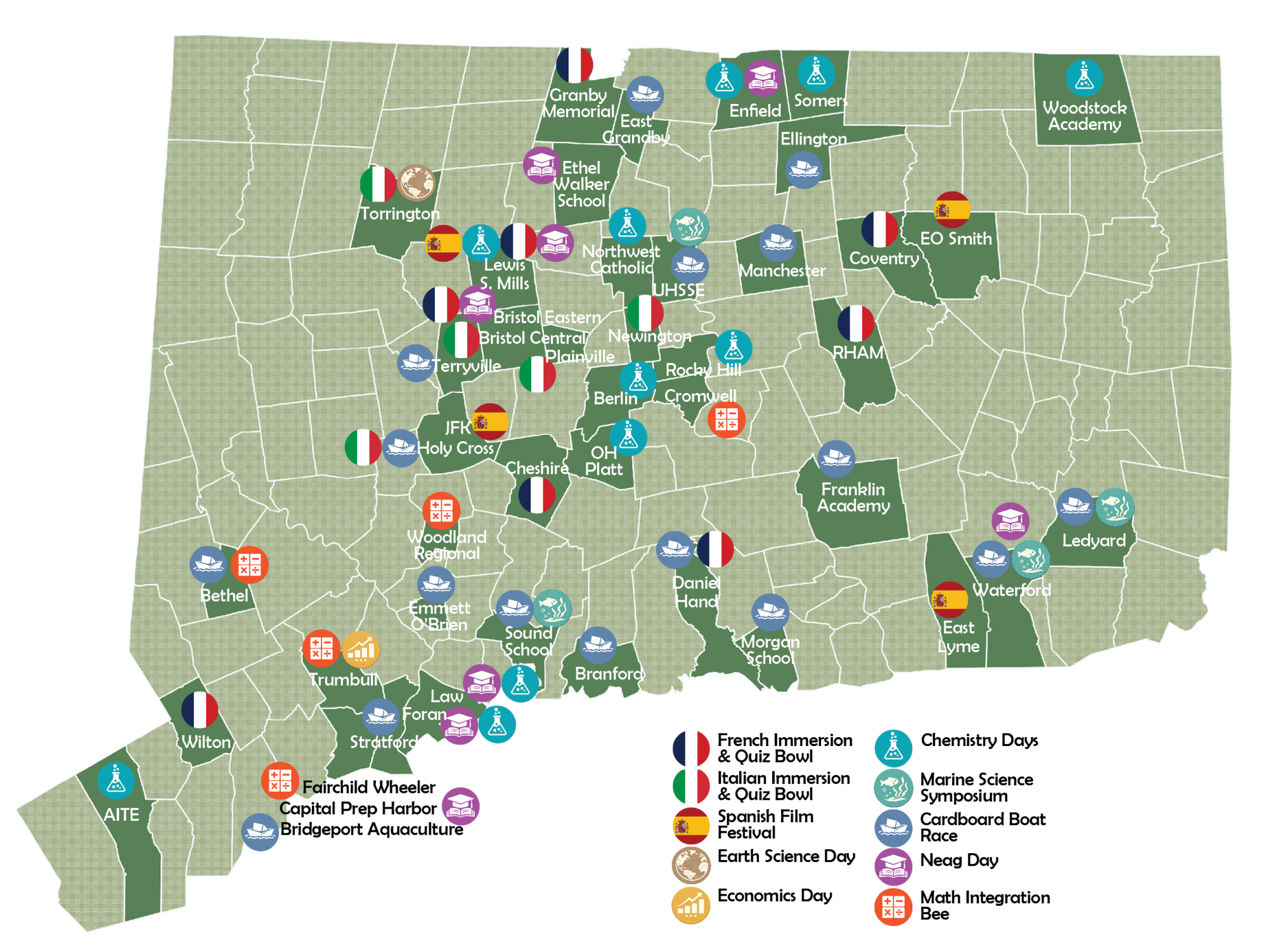
UConn ECE Student Events 26

This map of Connecticut highlights the high schools that participated in UConn ECE student events during the 2025–2026 academic year— an exciting year of growth for student engage­ment. Building on last year’s 14 student events, UConn ECE expanded to 16 student events in 2025–2026, creating even more opportunities for students to connect with the University and with one another.


Initially introduced in the winter magazine to showcase fall participation, this updated map now includes schools that participated throughout the spring semester as well. Each marker represents a high school whose stu­dents attended at least one event, offering a clear visual of the program’s expanding reach. With more schools participating than in the previous year, the map reflects broader geo­graphic representation across the state.


This increased participation is a testament to the continued dedication of UConn ECE in­structors and students, whose enthusiasm for academic enrichment drives the success of these events. As interest continues to grow, UConn ECE looks forward to further expanding access and encouraging more high schools to take advantage of these meaningful, hands-on learning experiences across a wide range of disciplines.


Read more…