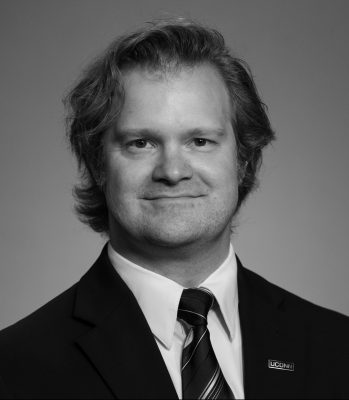
by Melanie Banks
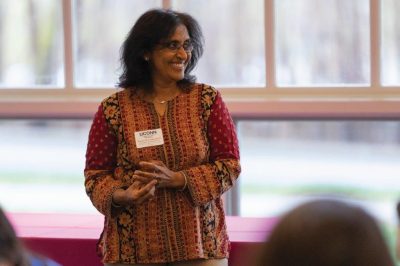
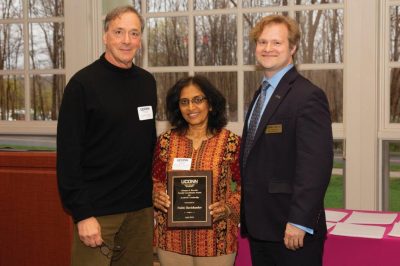
Get to know our faculty and learn some tricks of the trade with advice they have to offer. To answer some questions about her personal and professional interests, we are giving the spotlight to Nalini Ravishanker, UConn Faculty Coordinator for Statistics and 2018-2019 award winner of the Thomas E. Recchio Faculty Coordinator Award for Academic Leadership.
- How did you get involved with UConn ECE?
It was a while ago, when UConn ECE was called the UConn High School Co-op Program. I liked what I heard about the program either through the UConn Mentor Connection or from our Department Head, Uwe Koehn, and agreed to become the faculty coordinator for Statistics. I am sure I must have continued to like it a lot, since I am still here! - Where did you go to college, and what attracted you to statistics?
My Undergraduate major was in Statistics at Presidency College, Chennai, India. I got my PhD in Statistics from NYU. I have always been attracted to Mathematics and recall deciding to major in statistics when I heard someone say it combined Math with the randomness that arises in practical applications. I think this now has a cooler name: “Uncertainty Quantification (UQ)”. - What is your philosophy of teaching and learning?
I think my philosophy in teaching is to make sure the material reaches each learner. A friend recently suggested I do the semi-flipped classroom format, which I think both my students and I like a lot. - What are your hobbies?
I like gardening, indoor and outdoor. - What was your favorite course you took in your undergraduate career?
As an undergraduate, I liked Linear Algebra a lot. - What is the best advice an instructor can give to their students?
I like to ask my students whether they wish to really learn the material or be satisfied with the perception of having learned the material. - What would you recommend students do to succeed in a UConn ECE course?
The UConn ECE Statistics course is the first real introduction students get to statistics. I think the teachers in our high schools build enthusiasm through a variety of examples that resonate with their students. It would be great if the students catch the enthusiasm from their teachers, and if they are also strong in calculus, consider majoring or minoring in statistics. Their teachers and I can give them more information. - If you could only eat one thing for the rest of your life, what would it be?
As a South Indian (Tamil) girl, I should say “rasam sadam” (white rice with a tomato based thin soup), but I am going to go healthy and say spinach.
 Through supportive and caring faculty members, our students are able to feel a sense of pride and accomplishment while attending Pre-College Summer. This relates to students' readiness to learn in a college setting and the ability to see how their passions may transform into a college major. Dr. Kimberly Bergendahl, Assistant Professor in Residence from the Political Science Department and Pre-College Summer faculty of the Pre-Law course, has had wonderful experiences with Pre-College Summer students, both during and after their time at UConn Pre-College Summer. Dr. Bergendahl has connected with students during their time in the program and is currently working with a former PCS student, now a UConn honors student, studying political science and conducting undergraduate research. This continued collaboration is an example of how our faculty members can foster incredibly transformative learning experiences through the Pre-College Summer Program that help students build connections and guide them toward a path to success.
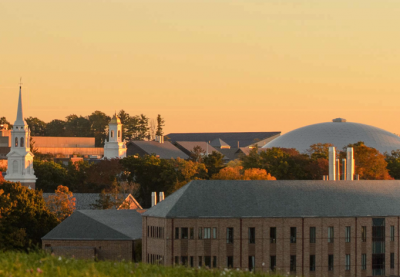 Being a student is an important role and a title that is central to my identity. I love learning and the longer I have been a student, the clearer it becomes that sharing my thoughts and passions on what I read is central to being a great student. We should always be considering and reevaluating our academic passions, as well as sharing our thoughts with important people around us. When I graduated high school I had pretty clear ideas on what I wanted to study but not very clear ideas on how I was going to use it. I loved foreign languages and politics. I was lucky to have studied Russian throughout my four years in high school and was very excited to continue learning Russian and start learning German at UConn. Some people encouraged me to go into international business, because, that's where the money is. Luckily I was surrounded by people who supported my interests and allowed me to focus my passions without monetizing them. It made my studies and self discovery that much more enriching. I did not go into business; rather, I stayed at the interesting crossroads of language, culture, and politics. True to a liberal arts education, my degree prepared me to do a broad array of things because I learned how to analyze and problem-solve and was practiced at applying rigorous methodologies of inquiry. All of these skills have benefited the Office of Early College Programs and allowed me to do interesting things with my life.
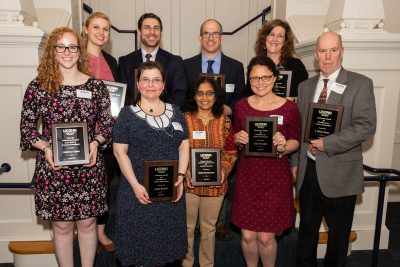 We recognized all award winners at our annual Awards Ceremony in April, presenting them with a plaque and a monetary award over a celebratory dinner with family, friends, and colleagues. It was a night full of admiration and appreciation for the dedication each award winner displays day in and out for their high schools and their students. All award winners have exceeded the program expectations and excelled in preparing their students for the next level in their education.
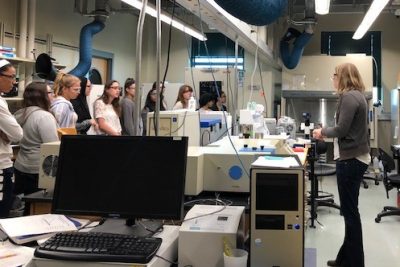 The April 25th Science Activity Day was coordinated by the UConn Early College Experience Program Office and Dr. Selampinar, with science activities hosted by Dr. Rouge and Dr. Ung and their graduate students (Alyssa H., Saketh G., Mark T., Kaitlynn A., Erin B., Nishya M., and Rebecca F.). To kick off the day's events, the high school students learned about how an interest in chemistry can prepare them for a variety of job paths, including working in a lab as a researcher someday. In the afternoon the students broke into two sections to learn about molecules that can fluorescence and about biomacromolecules that can build structures at the nanoscale. During Dr. Ung's activities, students were taught an overview of the principles of fluorescence and how light interacts with molecules. They made glow sticks and were exposed to scientific thinking. The students were asked to determine why molecules glowed and made simple hypotheses that they verified experimentally. Later, the students gathered and shared the results of their experiments to conclude the relationship between chemical structure and a molecule's ability to glow.
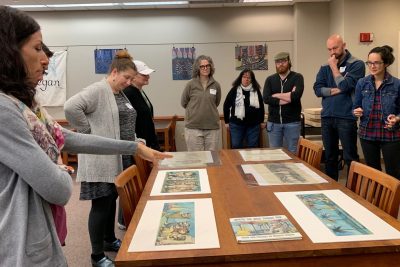 Art: Along with UConn ECE Faculty Coordinator, Cora Lynn Deibler, certified UConn ECE ART 1030: Drawing I Instructors were able to visit the Thomas J. Dodd Center on the Storrs campus to take a firsthand look at the Maurice Sendak archives. Recently, the Maurice Sendak Foundation chose to share Sendak's archives with the University of Connecticut who are now housing and stewarding the Collection. Project Archivist, Carla Nguyen shared her knowledge with the group who were able to learn more about Sendak's life, and view his original artwork, sketches, books and other materials.